Short answer: Street parking in Cabo San Lucas is free wherever the curb is painted white or not painted at all. Private lots charge roughly 30–50 MXN per hour, including the large pay lot by the marina near Tesoro Los Cabos. Downtown fills up fast on weekend nights, so for a night out on the strip the honest move is to take a taxi, use Uber, or walk from a marina hotel. Golden rule for the curbs: if it isn't white, it isn't yours.
Nobody flies to Cabo dreaming about parking, but if you've got a rental car — or you're deciding whether to get one — the rules here are genuinely different from home, and they're painted right on the curb. This is the local guide: what every curb color actually means, where the free parking is, what lots cost, and when you should skip the car entirely.
The curb-color decoder: what every color means in Cabo
Mexico speaks parking in paint. Instead of a forest of signs, the curb itself tells you whether you can leave your car there — and reading it wrong is the fastest way to come back to a ticket or a tow. Here's the full decoder:
| Curb color | What it means | Can you park there? |
|---|---|---|
| White / unpainted | Free public parking | Yes — this is your spot |
| Red | No parking, ever | No — never |
| Yellow | Taxi stands (sitios); in much of Mexico yellow also marks loading zones | No — either way, it isn't yours |
| Green | Commercial loading and unloading for permitted business fronts | No — deliveries only |
| Blue | Disability-permit holders only | Only with a valid permit |
The one to respect above all is yellow. Those are the taxi stands — the sitios — and the drivers who work them will not be shy about it if you're sitting in their spot. Whether a given stretch of yellow is a sitio or a loading zone doesn't really matter to you as a visitor: don't park on it.
If you remember one line from this whole guide, make it this: if it isn't white, it isn't yours.
Is parking free in Cabo San Lucas?
On the street, yes — anywhere the curb is white or unpainted, parking is free public parking. No meters, no apps, no permits. That's most of the residential and side streets around downtown, and on a quiet weeknight you can often find a free white-curb spot within a couple of blocks of wherever you're going.
When the free spots run out, you move to private lots, which charge roughly 30–50 MXN per hour — a few dollars, not a resort bill. The most useful one to know is the large pay lot by the marina, near Tesoro Los Cabos: it puts you within walking distance of the marina boardwalk and the downtown strip at once.
One more local trick: many waterfront restaurants validate parking — if you're eating somewhere near the marina, ask before you pay. A dinner receipt often turns your parking into part of the meal.
Parking for a night out downtown
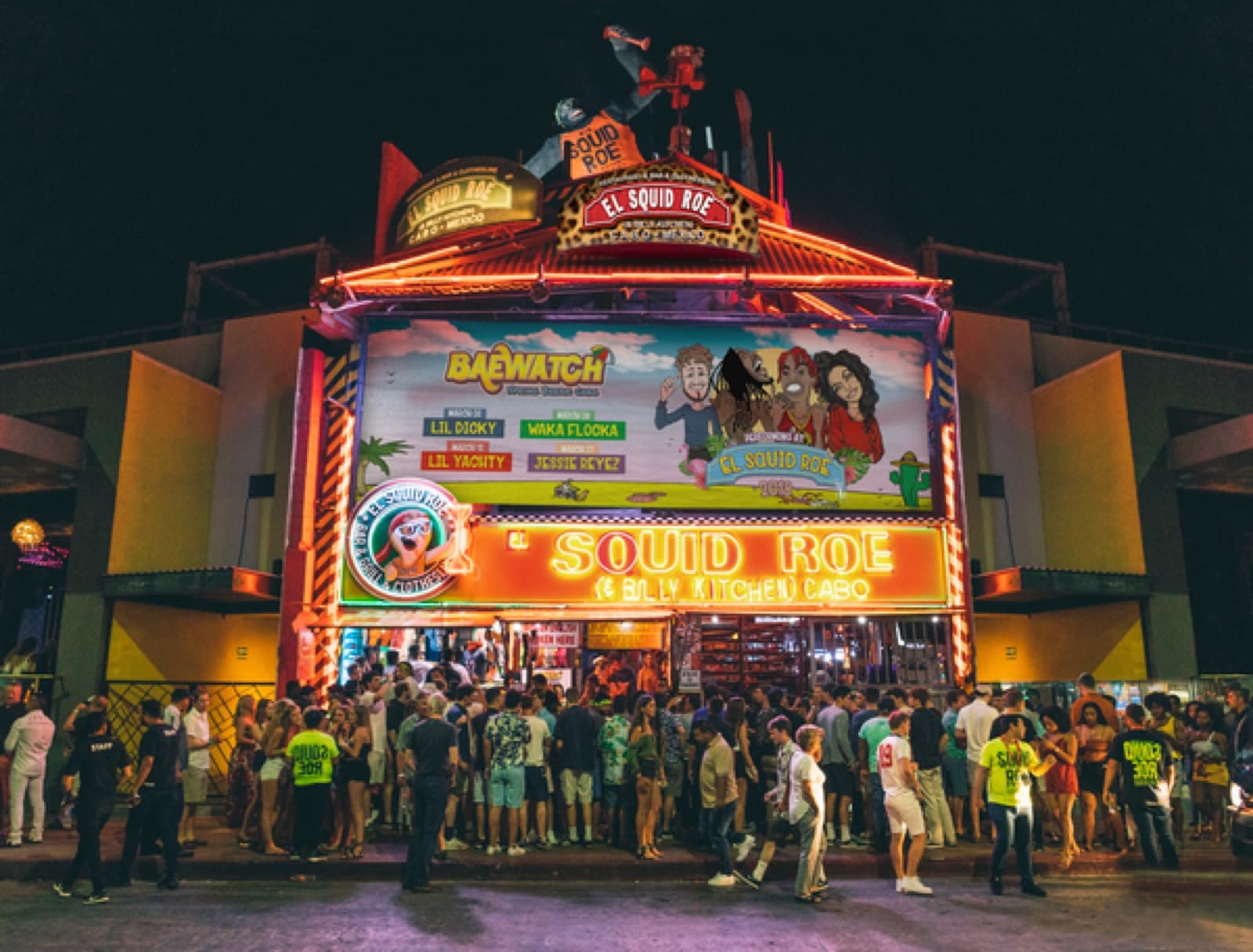
Here's where the honest local advice kicks in. Downtown Cabo — the blocks around Blvd. Lázaro Cárdenas where the nightlife is concentrated, El Squid Roe included — genuinely fills up on weekend nights. If you're set on driving, arrive before about 9 pm on a Friday or Saturday; after that you'll be circling while everyone else is already inside.
But the real recommendation is simpler: don't drive to the party at all. Take a taxi or an Uber, or just walk if you're staying at a marina hotel — downtown is that close. The strip is compact and walkable, the ride back costs less than a couple of drinks, and nobody in your group has to stay sober-adjacent to move a car at 2 am. The moment you drop the car, parking stops mattering entirely — and if you've reserved a table, you're walking straight from the curb to your spot. Full arrival details, including where taxis drop off, are on our getting here page.
Is driving in Cabo difficult?
Two different answers depending on where you are.
The highway: easy
Highway 1 and the Tourist Corridor between Cabo San Lucas and San José del Cabo are easy, well-maintained driving. If you can handle a highway at home, you can handle this one.
Downtown: tighter
Downtown Cabo is a different animal — narrow streets, one-way blocks, and busy foot traffic, especially at night. It's not dangerous, just slow and attention-hungry. Take it easy and watch for pedestrians who treat the street like a sidewalk, because on party nights it basically is one.
The one hard rule
Never drive Highway 1 outside town at night. Livestock wanders onto the unlit highway after dark, and a cow on a dark road is not a problem you want to meet at highway speed. Plan your drives to Todos Santos or the East Cape for daylight, every time.
Should you rent a car in Cabo?
Depends entirely on what your trip looks like.
Skip the rental if your trip is downtown and nightlife. The strip is walkable, taxis and Ubers are everywhere, and a car spends the week costing you money to sit still.
Rent one — figure roughly $150–250 USD per week — if you want Todos Santos, the East Cape, or the remote beaches. Those are real road trips, and a car is the only good way to do them.
If you do rent, know these three things before the counter:
- Mexican law requires third-party liability insurance, and many US credit cards' rental coverage does not satisfy it. Budget for the Mexican liability policy as part of the real price.
- Decline double coverage where your own policy genuinely applies — but only where it genuinely applies. Liability is the non-negotiable piece.
- Watch for the gas-station short-change scam. Attendants pump for you in Mexico; the classic move is a sleight-of-hand on your bills. Count your money out loud as you hand it over and the problem disappears.
More trip-planning basics like this live in our know before you go guide.
Frequently asked questions
How much is parking in Cabo?
Street parking is free wherever the curb is white or unpainted. Private lots — including the big one by the marina near Tesoro Los Cabos — run roughly 30–50 MXN per hour, and many waterfront restaurants validate if you ask.
Can you park on the street in Cabo?
Yes, and it's free — as long as the curb is white or unpainted. Red means never, yellow belongs to the taxis, green is commercial loading, and blue requires a disability permit. If it isn't white, it isn't yours.
What do the curb colors mean in Cabo?
White or unpainted = free public parking. Red = no parking, ever. Yellow = taxi stands (and in much of Mexico, loading zones). Green = commercial loading and unloading. Blue = disability-permit holders only.
The bottom line
Parking in Cabo is easy once you can read the curbs: white is free and yours, everything else isn't. Lots cost pocket change, the marina lot near Tesoro covers you downtown, and restaurants often validate. And for the big night out on the strip? Leave the car at the hotel, grab a taxi, and walk in like everyone who lives here does — if the night ends at El Squid Roe, the best parking spot is the one you never needed.
Ready to plan your night?
Lock in your table with a low deposit — credited 100% to your tab, free date changes.

Diego writes from inside El Squid Roe — the world-famous club at the heart of downtown Cabo San Lucas nightlife since 1989. He covers bookings, bottle service, and what actually makes a night here work.